DIGIT TM III is awarded. Now the CV decides.
· Work for International Organizations
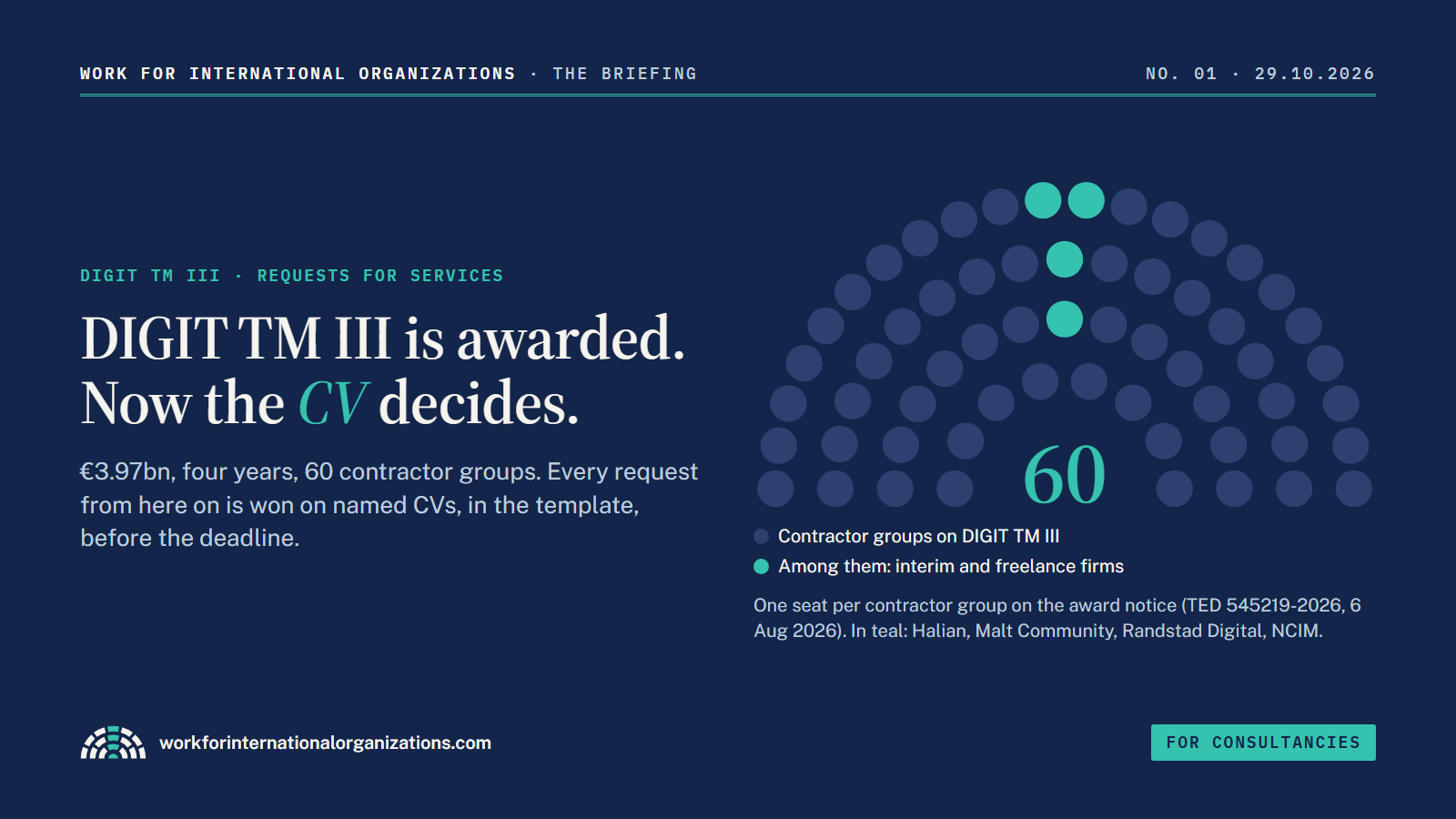
On 6 August 2026 the European Commission published the award of DIGIT TM III, its framework for external IT services in time and means across the whole digital solution lifecycle. It runs for four years, it is worth up to €3.97 billion, and it went to 60 contractor groups across three lots.
For most of those groups, the hard part starts now. Being on the framework gives you the right to answer requests for services. It does not win any of them.
What was awarded
The award notice splits the ceiling into three lots:
- Far-site, all places of delivery: €1.40bn
- Near-site, Brussels and Geel: €2.01bn
- Near-site, Luxembourg, Ispra, Seville, Karlsruhe, Petten and Grange: €569m
The list of winners mixes the long-standing suppliers to the institutions with newer names. Among them are interim and freelance firms such as Halian, Malt Community, Randstad Digital and the Nederlands Centrum voor Interim-Management, etc. That alone says something about where the market is going: the institutions are buying people, and the companies that are good at finding people have noticed.
All figures are ceilings stated in the notice, not spend. How much each contractor actually bills depends on one thing: how many requests for services it wins.
How a request for services is won
Under a time-and-means framework, the work arrives as requests. A Commission service needs, say, a senior Java developer near-site in Brussels, or a business analyst far-site, from a given date. The contractors on the framework answer with named experts and their CVs. The decision usually rests on two or three CVs, judged against the profile.
Getting onto the framework was the first step. Every request after it is won on named CVs, in the template, before the deadline.
Three things decide whether your answer is the one that wins.
1. The person exists, is free and wants the role
A request is not a vacancy you can advertise for a month. The deadline is short, and the expert has to be available on the start date and willing to commit. A strong CV for someone who has just signed elsewhere is worth nothing. The contractors that win consistently have people ready before the request lands, not after.
2. The CV is in the template, and the months add up
TM III, like most institutional frameworks, has its own CV template. Experience is not read as a story; it is counted. Evaluators look at months per project and months per skill, and a CV that leaves them to do the arithmetic loses points it should have won.
That means rewriting every CV in the template, taking the months from the actual project dates, and counting each calendar month once, even when two projects overlap. It also means listing a technology against a project only when the candidate confirms they used it there. An evaluator who finds a claim the dates can't support stops trusting the rest of the CV.
3. One expert, one offer
When several contractors compete for the same request, an expert who appears in two offers is a problem for everyone. Keep a record of every offer, and never let the same person be proposed by two competing contractors for the same request.
What the best-prepared contractors are doing now
The first months of a new framework set the pattern. Contractors that answer the early requests well tend to keep winning; the ones that miss them spend the next four years catching up. A few habits make the difference:
- Map the profiles you expect. The previous framework and the Commission's current projects tell you which roles will come up most: developers, testers, analysts, architects, project managers, etc. Build a shortlist for each before the requests arrive.
- Cover the places of delivery you don't. Near-site lots tie experts to Brussels, Geel, Luxembourg, Ispra, Seville, Karlsruhe, Petten and Grange. If your bench lives elsewhere, you need people who already live near the site or will move there.
- Treat the template as a product, not a chore. A CV team that reformats under deadline pressure makes counting mistakes. A process that counts months from dates, checks overlaps and gets the candidate to approve the final CV removes them.
- Get the paperwork ready. Availability statements, language levels, diplomas, security clearance where needed. Missing a signature on the deadline day is the most avoidable way to lose.
Where we fit
Work for International Organizations finds experienced IT and project specialists for the consultancies that hold framework contracts with international organisations and institutions. For a TM III request, that means:
- named experts who are available and want the role;
- CVs in the template, with months per project and per skill counted from the dates;
- every CV checked by the candidate before it reaches you;
- each expert offered to one contractor per request, with every offer on record;
- working as your subcontractor, under your name: we never contact your client about your contract.
Most contractors don't need us for every request. They need us for the ones their own bench can't cover: a rare stack, a near-site place of delivery, or a deadline that is simply too short.
Send us your next request
Have a TM III request on your desk this week? Send us the profile, level, place of delivery and deadline, and we'll come back with the experts we can put forward. Or send one CV you already have, and we'll return it in the template with the months recounted.
Source: TED award notice 545219-2026, published 6 August 2026. Work for International Organizations is independent and is not part of, or endorsed by, any organisation or institution named here.